





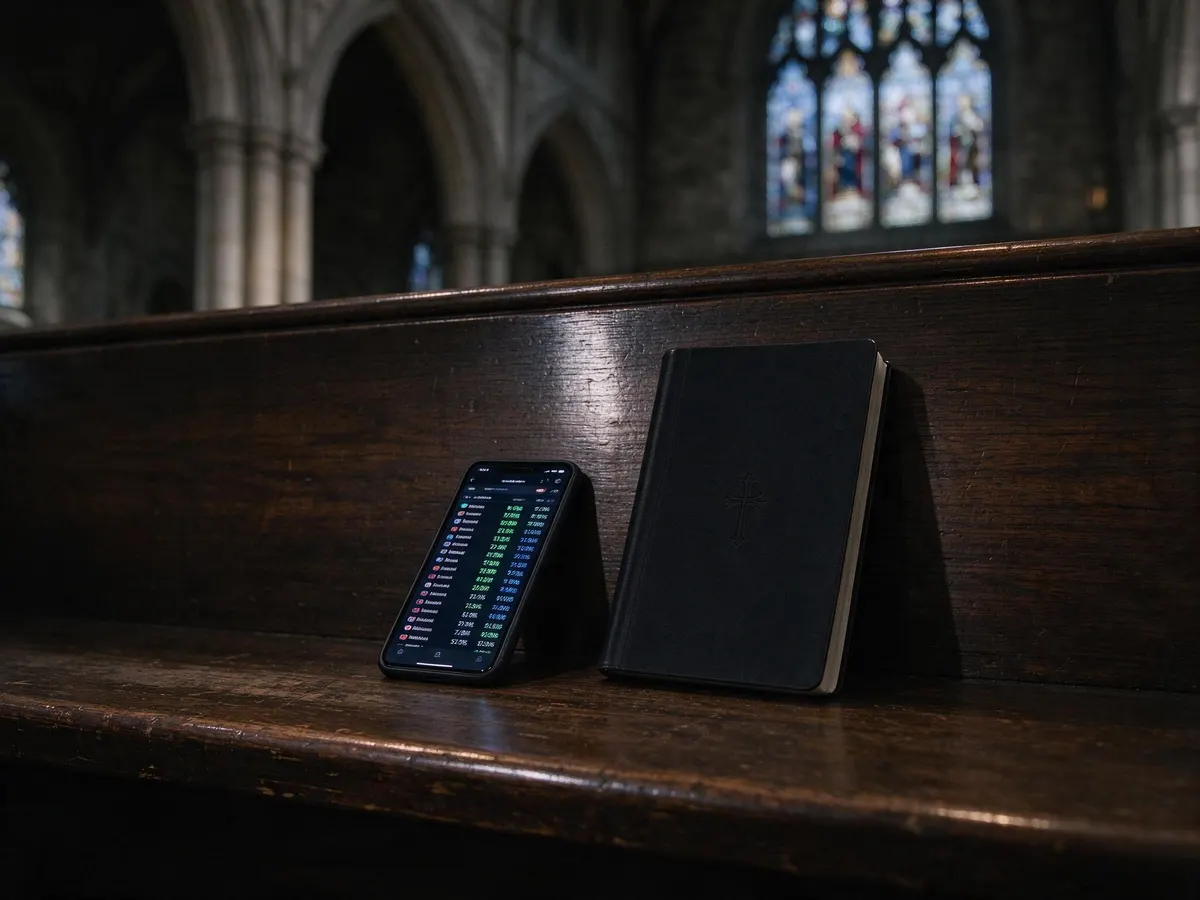
Explore the ethical and social arguments religious leaders make against mobile sports betting, including addiction concerns and community impact.
The religious case against mobile sports betting
Mobile sports betting is a legal, regulated entertainment product you tap into on a phone. That definition holds up for about as long as it takes to notice the phone is also in your pocket during work, at dinner, in bed, and in the pew. That shift in availability, more than the betting itself, is what pushed the mobile sports betting debate out of gambling-policy circles and into sermons.
The most recent high-profile example came from D. Todd Christofferson, Second Counselor in the First Presidency of The Church of Jesus Christ of Latter-day Saints, who used his October 2026 general conference address in Salt Lake City to call gambling in all its forms morally wrong. The church’s opposition is not new. His argument about why it now matters more is.
“The smartphone has transformed gambling from an occasional activity requiring a trip to a casino, racetrack, or lottery kiosk into an activity available continuously, privately, and almost anywhere,” he said, naming three drivers of growth: mobile sports betting, iGaming, and online prediction markets. He had some fun with the last one, noting that prediction markets can be tied to interest rates, elections, sports, wildfires, or “if you can imagine, the timing of the Second Coming.” Then the dry follow-up: “Where do you go to collect on that bet?”
Strip out the theology and the sports betting criticism in that address has three distinct parts. First, a stewardship claim: money and time are held in trust, so the test is not whether a purchase is legal but whether it builds anything. Second, a productivity claim, that “gambling produces nothing of value and enriches only its purveyors.” Third, a displacement claim, that even casual play pulls attention away from obligations the believer considers more serious. Christofferson served in the Quorum of the Twelve Apostles from April 5, 2008 until October 2025, when he was sustained as Second Counselor under President Dallin H. Oaks, so this is doctrine spoken from the church’s governing centre, not a one-off opinion.
Other traditions arrive at similar conclusions by different routes. Islamic teaching prohibits maysir outright. Many evangelical and Methodist bodies have long-standing statements against gambling built on stewardship and concern for the poor. Catholic teaching is more permissive in principle, treating moderate wagering as morally neutral while condemning betting that deprives someone of what they need for their family. The faith-based opposition is not one position but a cluster of them.
Faith-based objection versus secular criticism: two different questions
This is the distinction most coverage flattens, and it matters if you want to follow the argument. Religious critics are usually making a claim about the act. Public health critics are usually making a claim about the aggregate consequences. One can be true while the other is contested.
A faith-based objection does not depend on harm data. If gambling is wrong because it seeks gain without work, or because it treats money held in stewardship as something to risk for amusement, then a bettor who stakes £10 a month, never chases a loss, and never misses a bill is still doing something the tradition rejects. Harm statistics are beside the point.
Secular criticism runs the other way. It largely concedes that most adults who bet do so without damage, then argues that the minority who are harmed are harmed badly, that the product design contributes to it, and that the social costs land on people who never placed a bet. That argument lives or dies on evidence.
| Question | Faith-based framing | Public health framing |
|---|---|---|
| What is being judged? | The act of wagering itself | Population-level harm and product design |
| Does moderate betting pass? | Generally no | Usually yes, with safeguards |
| Core concern | Stewardship, agency, character, displacement of duty | Addiction, debt, mental health, family and community cost |
| What would change its mind? | Little, by design | Better data on prevalence and harm reduction |
| Preferred remedy | Personal abstention, taught and encouraged | Regulation, limits, treatment funding |
Where the two overlap is accessibility. A bishop worried about a congregant’s soul and an epidemiologist worried about relapse rates will agree on one practical point: a product that is available every second of every day is harder to keep at arm’s length than one requiring a drive to a casino.
Why the phone changed the gambling addiction conversation
Gambling addiction concerns predate the app store by several thousand years. What changed is friction, and friction was doing more work than anyone appreciated.
Three features of mobile betting do most of the heavy lifting in the harm argument. Continuous availability removes the natural stopping points that a venue imposes by closing. In-play markets compress the cycle between stake and result to seconds, so a bettor can place dozens of wagers during one match rather than one before kick-off. And privacy removes the social check, because nobody sees you open an app at 2am the way they would see you walk into a betting shop.
Push notifications, personalised odds boosts, and stored card details all point the same direction. None of this makes an individual bet unfair, and licensed sportsbooks in regulated markets run on published prices with an overround, the bookmaker’s built-in margin, baked into them. That margin is the honest part: it is why the operator profits over time and why sustained betting has negative expected value. The design concern is about frequency and impulse, not about whether the odds are rigged.
On numbers, be careful with anyone who sounds certain. Problem gambling prevalence estimates vary widely depending on the screening tool, the country, and the survey year, and researchers disagree about how much of the online figure reflects causation rather than the fact that heavier gamblers migrate to the most convenient channel. What is consistently reported is that online and in-play bettors show higher rates of problem gambling indicators than people who only bet in person, and that problem gambling helplines in multiple US states recorded rising contact volumes after mobile sportsbooks launched following the Supreme Court’s 2018 decision striking down the federal ban. Those are signals worth taking seriously. They are not the same as a clean causal estimate.
What the evidence says about families and communities
The social harm argument has the strongest claim in the whole mobile sports betting debate, because the costs are not confined to the person betting. Research on gambling harm consistently finds that each person with a serious problem affects several others: partners dealing with hidden debt, children in households under financial stress, employers absorbing lost productivity, and in some cases family members facing the fallout of borrowing or theft.
Two further concerns come up repeatedly and deserve to be stated plainly rather than inflated. One is the sheer volume of betting advertising attached to sport, which makes the activity feel like a normal part of watching a game for people, including minors, who are not the intended audience. The other is distributional: studies of gambling spend generally find that losses are not spread evenly across income bands, which is why many religious statements single out the effect on people with the least room to absorb a loss. Christofferson’s framing, that gambling “enriches only its purveyors,” is a moral version of the same observation.
The counter-evidence deserves equal airtime. Most people who bet on sport do it occasionally, in small amounts, and stop when the season ends. Legal markets generate tax revenue, some of which funds treatment, and they pull activity away from unlicensed sites that offer no consumer protection, no identity checks, and no complaints process. A neutral reading is that legalisation has traded one set of harms for another, and the honest question is whether the swap is net positive. That depends heavily on how tightly the market is regulated.
The industry’s answer: responsible gambling tools and their limits
Operators and regulators do not usually dispute that a minority of customers are harmed. Their position is that the answer is controlled supply with built-in brakes. In practice that means a standard toolkit, and if you bet at all it is worth knowing what is sitting in your account settings:
- Deposit, loss and stake limits you set yourself, which cannot be raised instantly in most regulated markets.
- Session time limits and reality checks that interrupt play with a reminder of how long and how much.
- Cool-off periods lasting from a day to several weeks.
- Self-exclusion, including national schemes that block you across every licensed operator at once.
- Affordability and behavioural monitoring, where operators are required to intervene when patterns suggest harm.
- KYC and age verification, which exist partly to keep under-18s out.
These tools work for people who use them, which is the catch. Uptake is low, the brakes rely on the person most likely to want to keep playing choosing to apply them, and enforcement quality varies enormously between jurisdictions. Religious critics make a sharper version of the same point: a harm reduction framework assumes the activity is worth preserving, and that is precisely what they deny. Telling someone who believes gambling is wrong in principle that they can set a monthly deposit cap is answering a question they did not ask.
Regulation, prohibition, or simply not playing
There are really three live positions, and they can be ranked by how much they ask of whom.
Prohibition asks the state to remove the option. Utah, home to the church in question, still bans commercial gambling entirely, which is the clearest working example in the United States. Opponents argue bans push demand to offshore sites and leave no safety net; supporters point out that availability is the single strongest predictor of participation, and a ban removes it.
Tight regulation asks operators and governments to absorb the cost of harm: advertising restrictions, affordability checks, ad-free match broadcasts, stake caps, mandatory levies funding treatment and research. Most Western markets have been moving in this direction, with varying conviction.
Personal abstention asks nothing of the state at all, which is why it is the remedy most faith communities actually preach. Christofferson’s closing line was a plea rather than a policy proposal: “I am pleading with all of us to live life on a higher plane.” Whatever you make of the theology, it is a coherent position, and it sidesteps the enforcement problems the other two run into.
Problem gambling awareness is the one thing all three camps can support without conceding anything. If betting has stopped being entertainment, or you are chasing losses, hiding spend, or borrowing to stake, free and confidential help exists. In the US, the National Council on Problem Gambling operates the National Problem Gambling Helpline, now branded as 1-800-MY-RESET, with the historic 1-800-GAMBLER number still used by some regional and affiliate programmes, and maintains resources at ncpgambling.org. In the UK, GamCare operates the National Gambling Helpline. Most licensed operators will also let you self-exclude in under two minutes, and that option is permanent enough to be worth taking seriously before you need it. Gambling is a paid form of entertainment with a built-in house edge, never a way to make money, and anyone under the legal age in their jurisdiction should not be betting at all.