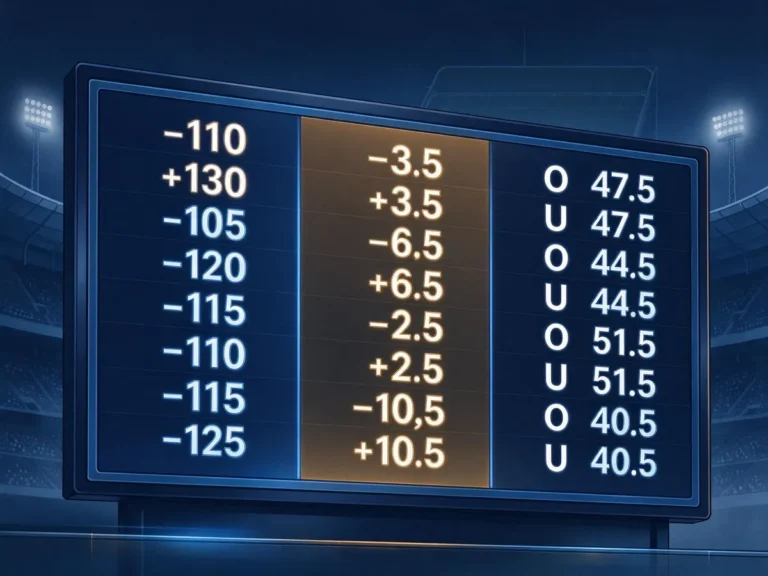





Prediction markets explained: how event contracts differ from sportsbook odds, what the Illinois court ruling changed, and what it means for players.
It’s late in the third quarter and the same outcome is sitting on two screens in front of you. On the left, a sportsbook has your team at 1.57 to win, fixed, take it or leave it. On the right, a prediction market has a contract on the same team trading at 62 cents, and the price is twitching every few seconds as other users buy and sell. Same event, same question, two completely different machines underneath.
That gap is what this article is about. Prediction markets explained properly is less a legal story than a mechanical one: who sets the price, who takes the other side, and who regulates the whole thing. The recent Illinois federal court ruling in favour of Kalshi made the legal question front-page news in the betting industry, but the mechanics came first and they’re what actually change your experience as a user.
What prediction markets are, in plain terms
A prediction market is a platform where users trade contracts on the outcome of a future event. You aren’t placing a wager with the house. You’re buying a position from another user who thinks the opposite, and the platform matches the two of you and takes a fee.
The contracts are binary: the event happens or it doesn’t. Hold a winning contract to settlement and it pays out a fixed amount, usually $1. Hold a losing one and it’s worth nothing.
How event contracts work
Go back to that 62-cent contract. You buy ten of them for $6.20. If your team wins, each settles at $1 and you collect $10 — a $3.80 profit on $6.20 risked, which is the same shape as decimal odds of about 1.61.
The price itself is a probability statement. 62 cents means the market collectively prices that outcome at roughly a 62% chance. And here’s the part that genuinely differs from a betting slip: you don’t have to wait for the final whistle. If the price climbs to 78 cents at the two-minute warning, you can sell your contracts to someone else and bank the difference, or cut the position at 40 cents if the game turns. The position is tradable right up to settlement.
The “no” side exists too. Someone sold you those contracts at 62 cents, meaning they effectively hold the opposite position at 38 cents. The two sides sum to a dollar. That’s the structural signature of an exchange.
Market-based pricing versus fixed odds
Nobody at the prediction market decided the price was 62 cents. The order book did — bids and offers from traders, with market makers posting prices on both sides to keep liquidity available so your order actually fills. If sentiment shifts, the price shifts.
A sportsbook works the other way. Its traders and models set a price, publish it, and adjust it based on their own risk exposure and money coming in. You get a number, not a negotiation.
How a sportsbook does the same job
A traditional sportsbook is the counterparty. When you back that team at 1.57, the operator holds the other side of your bet. It wins when you lose. To make that sustainable regardless of results, it builds a margin into the prices.
Say the book offers 1.57 on one team and 2.30 on the other. Convert those to implied probability: 1 ÷ 1.57 = 63.7%, and 1 ÷ 2.30 = 43.5%. Add them up and you get 107.2%, when real probabilities can only total 100%. That extra 7.2 points is the overround — the bookmaker’s margin, the same concept as the house edge on a casino game. It’s why sports betting regulation in most markets treats sportsbooks as gambling operators: the business model is accepting wagers against the customer at prices tilted in the operator’s favour.
None of that is a criticism. It’s just the design. A sportsbook guarantees you a price and guarantees your bet gets accepted, and it charges for that through the margin. An exchange charges a fee instead and leaves you to find a counterparty.
Prediction markets vs betting: the differences that matter
Three differences do most of the work: who you’re trading against, how the platform makes money, and which rulebook it answers to.
Market structure
Peer-to-peer versus house-versus-player. On a prediction market, liquidity is everything. A heavily traded NFL market might have tight spreads and plenty of depth; an obscure market might show you a bid of 30 and an offer of 55, which is a terrible place to trade. Sportsbooks don’t have that problem — they’ll always quote you something, even on a niche market, though the margin on those niche prices is usually fatter.
Risk and profit models
The exchange is, in principle, indifferent to the result. It earns fees on volume. A sportsbook carries genuine book risk on individual events and manages it with pricing and limits. For you as the user, the practical consequence is where the cost sits: baked into the odds at a sportsbook, charged as an explicit fee on a prediction market.
What doesn’t change is the basic arithmetic of risking money on uncertain outcomes. Fees and spreads are a real cost, and over many trades they come out of your results the same way an overround does. Neither model hands you an edge.
Regulatory classification
This is the fault line. In the US, sportsbooks are licensed state by state under state gambling law. Prediction market operators argue their products are derivatives — swaps, specifically — regulated federally by the Commodity Futures Trading Commission, the same framework that covers other event contracts and financial derivatives. Two different rulebooks, two different sets of consumer protections, two different enforcement bodies.
| Feature | Prediction market | Sportsbook |
|---|---|---|
| Counterparty | Another user | The operator |
| Price setting | Order book, market makers | Operator’s traders and models |
| Operator revenue | Trading fees | Margin built into odds (overround) |
| Exit before settlement | Sell the position at market price | Cash out, if offered, on operator’s terms |
| Price format | Cents per contract (implied probability) | Decimal, fractional or American odds |
| US regulator (claimed) | CFTC, federal | State gaming regulators |
| Typical extras | Rare; no bonuses or free bets | Welcome offers, free bets, loyalty schemes |
The Illinois ruling that put event contracts back in play
A federal judge in Illinois, US District Judge Martha Pacold, handed prediction markets one of their most significant recent wins. Kalshi, Coinbase and the CFTC had sued Illinois state regulators, and Pacold found that Kalshi’s core sports-related contracts are likely “swaps” under the Commodity Exchange Act. On that basis she concluded that several Illinois laws regulating those contracts likely conflict with federal law, and she granted the plaintiffs’ preliminary injunction requests in part.
Read that carefully, because the wording is doing a lot of work. “Likely” is the standard for a preliminary injunction, not a final judgment on the merits. The decision is partial. And it binds Illinois, not the country. If you’ve seen headlines suggesting prediction markets were just declared legal nationwide, they overstated it.
The same day, Ohio moved in the opposite direction, issuing or reasserting cease-and-desist notices against ten companies after the Sixth Circuit sided with the state. So within a single news cycle you had one federal court leaning toward federal preemption and another state pressing ahead with enforcement on the back of an appellate decision in its favour. That split is the actual state of play.
Where the law stands right now
Federal derivatives law versus state gambling law
The central question is jurisdictional. If sports event contracts are swaps, they sit under the Commodity Exchange Act and the CFTC, and state gambling statutes arguably can’t reach them. If they’re wagers dressed up as derivatives, states keep their authority, along with the licensing regimes, tax rates and consumer safeguards that come with it.
Courts are not agreeing with each other yet, which is why the industry expects this to keep climbing the appellate ladder. Until there’s a settled answer, availability will keep varying by state, and operators may enter or exit a market depending on which ruling landed most recently.
Outside the United States
The friction isn’t American-only. Czech authorities moved to block Kalshi, and Brazil’s proposed betting ban attracted dozens of amendments as legislators argued over scope. Most jurisdictions outside the US have no separate category for sports event contracts at all, so regulators default to asking a simple question: does this look like gambling? If the answer is yes, gambling licensing rules apply, and an unlicensed platform gets blocked.
What this actually means if you’re a player
In the short term, less than the headlines suggest. Access still depends on where you are and which platform is operating there that week. The one practical rule worth internalising: a platform’s legal status in your jurisdiction is your problem too, because it determines whether you have any recourse if something goes wrong with a payout or a settlement dispute.
If you do compare the two models, compare like for like. Convert a contract price to implied probability and put it next to the sportsbook’s implied probability on the same outcome, then add in the exchange’s trading fee before deciding which is the better price. A 62-cent contract isn’t automatically better value than 1.57 at a book — it depends on the fee and the spread you actually pay to get in and out.
Two other differences people underestimate. Prediction markets generally don’t run bonuses, free bets or loyalty schemes, so there are no wagering requirements to read but also no promotional cushion. And the consumer protection tooling can differ: licensed sportsbooks in regulated markets are typically required to offer deposit limits, self-exclusion and reality checks, while a platform regulated as a derivatives exchange is built around a different compliance model. Check what tools are actually available before you fund an account, not after.
Finally, the honest framing. The exchange structure is more transparent about where its revenue comes from, but transparency isn’t an edge. Trading contracts on uncertain outcomes is still risking money on uncertain outcomes, and the fees and spreads are real. Stake only what you can afford to lose, set your own limits, and treat both models as entertainment rather than income. If it stops feeling like entertainment, use the limit and self-exclusion tools available to you, or contact a local problem gambling support service.