




Learn how sportsbook odds work using an Eagles vs Bears NFL example: moneylines, spreads, totals, implied probability and why betting lines move.
It’s Monday night in Chicago. The Bears are hosting the Philadelphia Eagles, starting quarterback Caleb Williams is out with a hamstring problem, and Case Keenum, a 38-year-old third-string quarterback who hasn’t started a game since 2023, is reportedly taking the snaps. Philadelphia is a 3.5-point favorite. Somebody put that number up days before the injury news landed, and somebody has been adjusting it ever since.
Understanding how sportsbook odds work means understanding that whole chain: where the first number comes from, what it is actually saying about probability, why it moves, and what the bookmaker charges you for the privilege of betting on it. This walkthrough uses the Eagles vs Bears matchup purely as an illustration. There are no picks here, no predictions, and no suggestion that any bet is a good one.
Where does a betting line come from before anyone has bet?
An opening line is a forecast, not a reaction. Before a single rupee or dollar is staked, an odds compiler (or more often now, a pricing model with a human checking it) produces an estimate of each team’s chance of winning and the likely margin. The posted odds are that estimate converted into a price, with the bookmaker’s margin added on top.
How the first number gets made
Most NFL pricing starts from power ratings: a numerical strength value for every team, updated weekly from results and performance data. If a model rates Philadelphia, say, four points stronger than Chicago on neutral ground, and home field in the NFL is worth roughly two points in most models, the raw line lands near Eagles by two. That raw number then gets adjusted for everything the model doesn’t already capture.
Many books also soft-launch early lines at lower limits. They post a number, accept small bets, watch who takes which side, and correct before the serious money arrives. The opening line you see is often already the product of a short private market.
What the odds compiler is actually looking at
- Personnel and injuries. A quarterback change is the single biggest swing in American football pricing. Williams out and Keenum in is exactly the kind of news that forces a rewrite. Tight end Dallas Goedert being out with an MCL issue matters too, just by a smaller amount.
- Situation. Rest days, travel, short weeks, and a standalone night game that changes preparation routines.
- Weather. Wind off the lake in Chicago hurts the passing and kicking game, which pulls a total downward more than it moves a side.
- Historical and situational data. How similar teams performed in similar spots, and how actual scoring has behaved relative to posted totals.
- Market information. What other books and exchanges are showing. No bookmaker wants to be the only one hanging an out-of-line number.
What do the three main numbers mean?
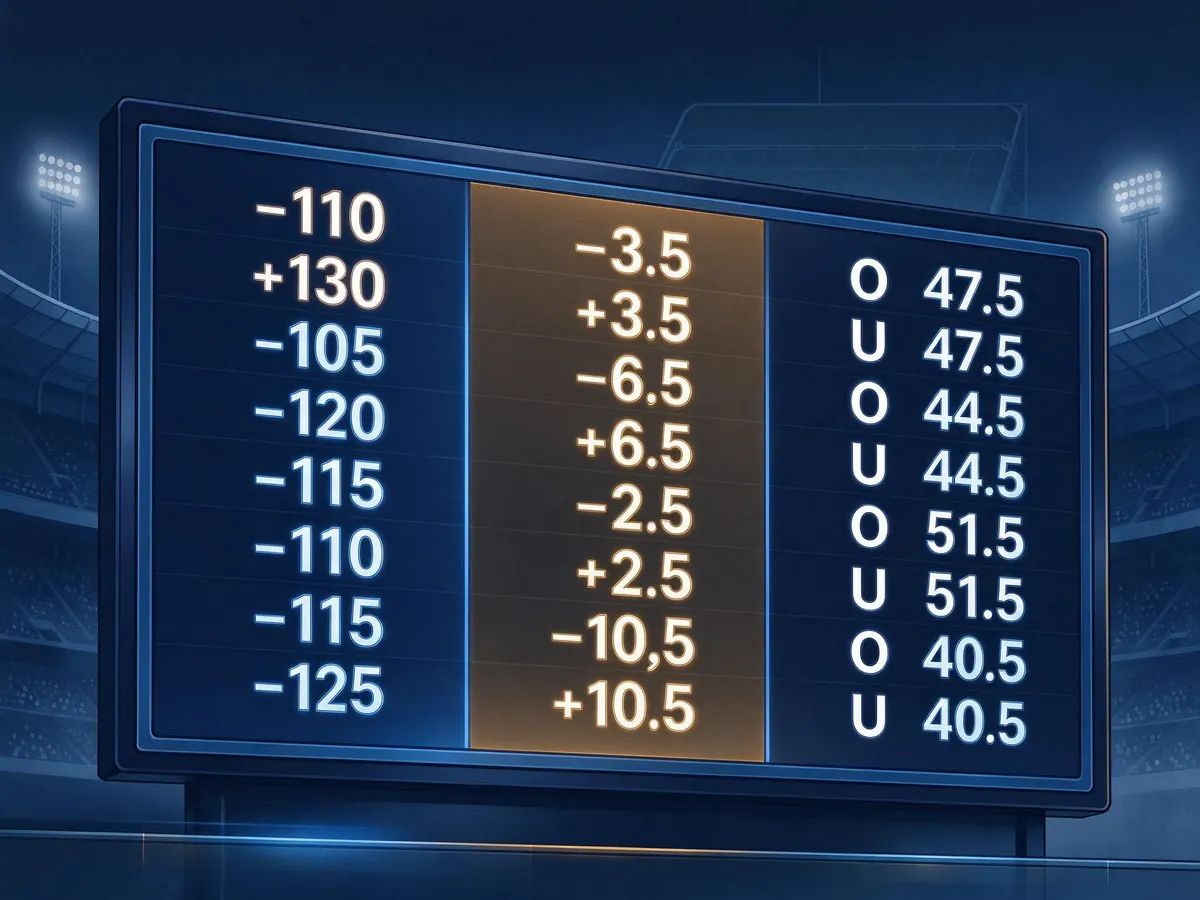
Reading betting lines for an NFL game comes down to three markets. Here is the Eagles vs Bears example in the format a book serving Indian players might show it, with both American and decimal odds, since most sites aimed at India display decimals by default.
| Market | Selection | American odds | Decimal odds |
|---|---|---|---|
| Moneyline | Philadelphia to win | -186 | 1.54 |
| Moneyline | Chicago to win | +186 | 2.86 |
| Point spread | Philadelphia -3.5 | -104 | 1.96 |
| Total | Over 41.5 points | +100 | 2.00 |
Moneyline: who wins, nothing else
The moneyline is a straight bet on the winner. The minus sign marks the favorite and tells you how much you must risk to win 100 units: at -186 you stake 186 to profit 100. The plus sign marks the underdog and tells you what 100 units returns: at +186 you stake 100 to profit 186. Margin of victory is irrelevant. A one-point Eagles win pays the same as a 30-point one.
Point spread: a handicap that levels the game
The spread exists because a straight bet on a strong favorite is unappealing at short odds. Philadelphia -3.5 means the Eagles must win by four or more for that bet to settle as a winner. Chicago +3.5 wins if the Bears win outright or lose by three or fewer. The half point removes the possibility of a push, which is what happens when the margin lands exactly on a whole-number spread and stakes are returned.
Over/under totals: combined points only
The total, or over/under, is priced on both teams’ points added together. With a total of 41.5, a 24-20 final (44 points) settles over; a 20-17 final (37 points) settles under. Who wins doesn’t matter. Totals are the market most sensitive to weather and to quarterback downgrades, because both tend to suppress scoring.
How do you convert odds into a probability?
Every price is a probability in disguise. Converting it is simple arithmetic, and it’s the single most useful habit a beginner can build, because it turns an abstract number into a percentage you can judge.
The two formulas for American odds
For negative (favorite) odds, implied probability = odds ÷ (odds + 100), using the number without its minus sign.
So for a -180 favorite: 180 ÷ (180 + 100) = 180 ÷ 280 = 64.3%.
Apply it to the actual example price of -186: 186 ÷ (186 + 100) = 186 ÷ 286 = 65.0%. That line is saying Philadelphia wins this game about 65 times in 100.
For positive (underdog) odds, implied probability = 100 ÷ (odds + 100).
For +186: 100 ÷ 286 = 35.0%. For a +150 underdog: 100 ÷ 250 = 40%.
With decimal odds it’s even quicker: implied probability = 1 ÷ decimal odds. So 1.54 gives 0.649, or roughly 65%, and 2.86 gives 0.350.
| American odds | Decimal odds | Implied probability |
|---|---|---|
| -186 | 1.54 | 65.0% |
| -180 | 1.56 | 64.3% |
| -110 | 1.91 | 52.4% |
| -104 | 1.96 | 51.0% |
| +100 | 2.00 | 50.0% |
| +150 | 2.50 | 40.0% |
| +186 | 2.86 | 35.0% |
Why the two sides usually add up to more than 100%
Notice something about -186 and +186: 65.0% plus 35.0% equals 100% exactly. That is what a two-sided market with no built-in margin looks like, which is typical of exchange and prediction-market pricing rather than a traditional bookmaker.
A sportsbook does not price that way. If the same game were offered at -180 on Philadelphia and +150 on Chicago, the implied probabilities would be 64.3% and 40.0%. Added together: 104.3%. That extra 4.3 percentage points is the overround, and it is the bookmaker’s margin. You cannot back both sides for a guaranteed return, because the book has shaded both prices in its own favor.
Why do odds change between the opening and kickoff?
A line is a living price. It moves when the book’s estimate of the true probability changes, or when its exposure gets lopsided enough to need correcting.
News that changes the forecast
Losing a starting quarterback is the clearest case. When Williams was ruled out and Keenum was named the likely starter, every model recalculated Chicago’s expected points, and both the spread and the total had to be repriced. Bookmakers normally pull the market down entirely while such news is confirmed, then reopen at a new number. Smaller adjustments follow secondary news: Goedert ruled out, Saquon Barkley cleared to play after a stinger, a worsening wind forecast.
Money, and whose money it is
Books also move lines in response to betting. Not all stakes carry equal weight, though. Sharp money, from bettors with a proven record and high limits, tells the book its number may be wrong, and a single respected wager can move a spread. Public betting, which flows heavily toward popular teams and toward overs on a national broadcast, mostly tells the book where its liability is building.
That is why a line can drift toward a favorite even when nothing new has happened: the book is nudging the price to make the other side more attractive and balance the book. For you, the practical consequence is that the number you see depends on when and where you look. Two sportsbooks can hold the same game at -3.5 and -4, and the price attached to each spread can differ too.
What is the vig, and what does it cost you?
The vig, also called juice or margin, is the fee baked into the odds. It is not charged separately. It is the reason both sides of a spread are usually priced at -110 instead of +100.
Work through it. At -110 you risk 110 to win 100. Suppose a book takes 100 on Philadelphia -3.5 at -110 and 100 on Chicago +3.5 at -110, so 220 in total. Whichever side wins, the book returns that bettor’s 110 stake plus about 100 profit, roughly 210, and keeps around 10. That is 10 out of 220 handled, a margin of about 4.5%.
Seen from the bettor’s side, the same thing shows up as a break-even threshold. A -110 bet has an implied probability of 52.4%, so you need to win about 52.4% of your -110 bets just to finish level. Winning half of them is a losing record. In the example above, Philadelphia -3.5 priced at -104 is slightly cheaper juice than the standard -110, and +100 on the over is cheaper still, which is why price shopping matters more than most beginners assume.
This is the honest core of how sportsbook odds work. The margin is structural, it applies to every market, and it compounds across parlays, where each leg carries its own vig. Over time, the house holds an edge by design. No reading of a line removes it.
What to take from the Eagles vs Bears board
Looking at that same set of numbers again, you can now read them as statements rather than symbols. Philadelphia at -186 is a claim that the Eagles win about 65% of the time. Philadelphia -3.5 at -104 is close to a coin flip on margin, with a small fee attached. Over 41.5 at +100 is an even-money read on combined scoring in a night game with a backup quarterback and lake wind in play. Whether any of those prices is accurate is a separate question, and not one this article answers.
Betting is entertainment with a negative expected return, not a source of income. Only stake money you can afford to lose, set deposit and loss limits before you start rather than during a bad run, and use the cool-off and self-exclusion tools your operator provides if betting stops feeling like a choice. Bet only where it is legal for you to do so and only if you are of legal age. If gambling is causing harm to you or someone close to you, contact a recognised problem-gambling helpline or support service in your country.