





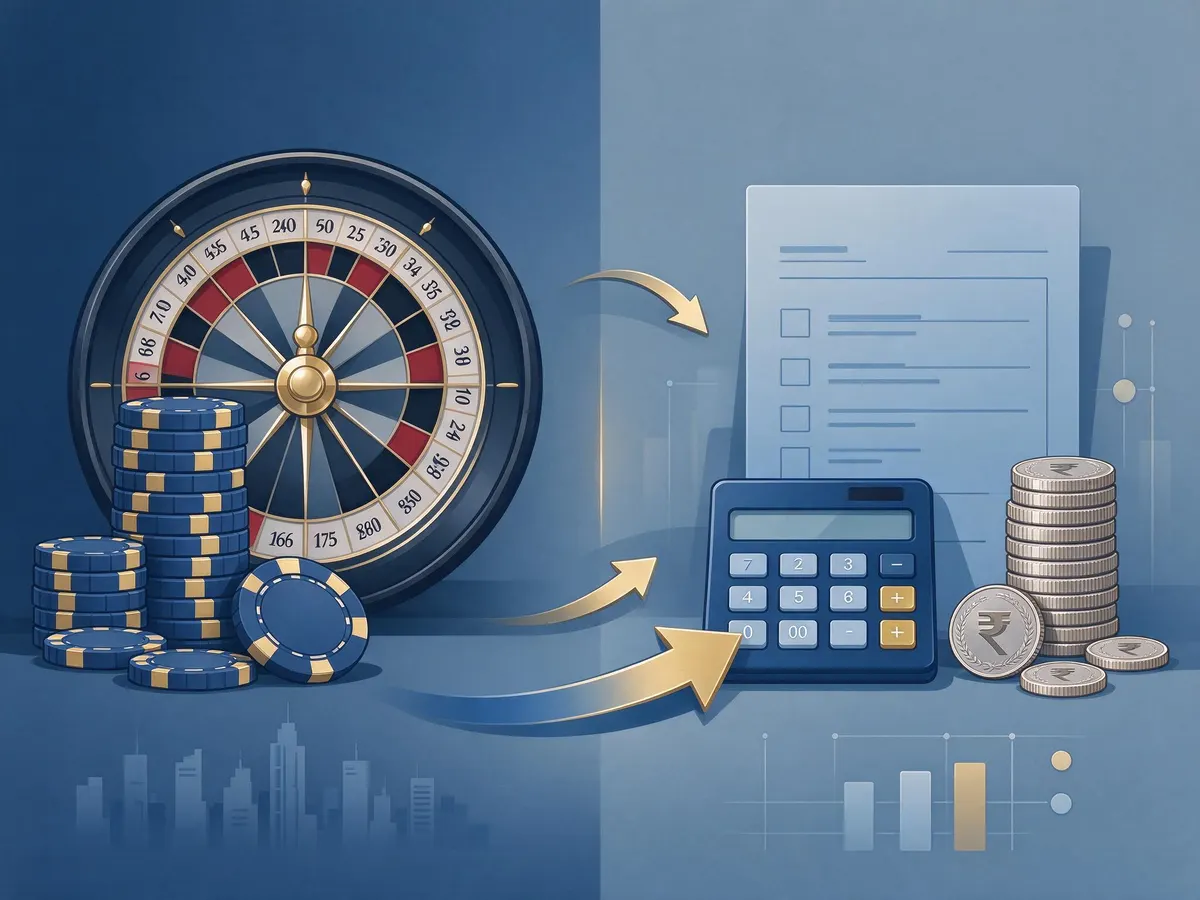
Gambling tax explained: how casino revenue is taxed, what Nevada's school funding myth reveals, and the TDS rules Indian players actually face.
A tour guide on the Strip says it every day: no state income tax in Nevada, a billion dollars a year in gaming taxes, so the slot machines must be paying for the schools. It sounds obvious. Then you open the state’s actual ledger and the story falls apart.
That gap between what people assume and what the numbers say is a useful starting point for anyone trying to get gambling tax explained properly. Casino taxation and player taxation are two separate systems, they’re built on different bases, and the balance between them shifts enormously from one country to the next. In the United States, operators shoulder most of the load. In India, the player does.
The Nevada schools myth, checked against the ledger
Nevada’s gaming taxes are real money, but they are not the backbone of public education in the state. They flow into the General Fund, where they make up roughly one-sixth of a $6 billion budget that covers statewide services, K–12 education among them. They don’t touch the much larger operating budgets of counties and cities at all.
What Nevada actually collects in gaming tax
The state collected $998 million in gaming percentage fees, against statewide sales tax collections of about $6.2 billion when state and local shares are combined. Sales tax is roughly six times the size of the gaming take. Of that $6.2 billion, the General Fund’s direct slice of sales tax runs $1.8 billion to $1.9 billion, comfortably ahead of what the casinos contribute.
Nevada built it this way on purpose. The tax system is anchored to general consumer spending rather than to gambling, which is a deliberate choice about volatility: people buy groceries in a downturn, they don’t necessarily fly in for a weekend at a resort.
Where that money really lands
Local school districts in Nevada depend mainly on sales taxes, property taxes, dedicated hotel room tax allocations and federal funding. The scale of local collections dwarfs state gaming fees. In fiscal 2024, Clark County alone collected around $2.85 billion in property taxes across overlapping local entities, with $1.07 billion going to county operations. Overlapping room taxes brought in roughly $1 billion, of which $81 million went to the county government.
There’s a second wrinkle. Strip resorts do pay a lot of tax, but most of it isn’t gambling tax. A modern Las Vegas resort generates about 26% of its revenue on the casino floor; the other 74% comes from rooms, restaurants, retail, shows and convention space. So most of what those properties remit looks like the commercial, property and lodging taxes any large hotel development pays anywhere in the country.
The fragility of the arrangement showed in September 2026, when Governor Joe Lombardo approved emergency measures after 15 school districts, Clark County included, recorded unexpected midyear enrollment declines. The state released $13.4 million in unspent education funds to head off immediate teacher layoffs. Not a gaming-tax rescue, a reallocation of existing education money.
How gaming taxes work on the operator side
Operators are typically taxed on gross gaming revenue, or GGR: total wagers minus winnings paid out. It is not profit. Salaries, rent, marketing and compliance costs come out after the tax, which is why the headline rate matters so much to where casinos choose to build.
Gross gaming revenue rates vary wildly
Nevada’s 6.75% top rate on gross gambling revenue is among the lowest in the United States. Other jurisdictions are far more aggressive, and the comparison explains why a Nevada casino can afford a buffet and a theatre while a slots parlour elsewhere cannot.
| Jurisdiction | What gets taxed | Headline rate |
|---|---|---|
| Nevada | Gross gambling revenue | 6.75% |
| Pennsylvania | Slot machine revenue | Roughly 54% |
| New York (Resorts World NYC) | Video lottery revenue | Effective 65%–70% |
| India (online money gaming and casinos) | Full face value of bets / chips purchased | 28% GST |
That last row is the one Indian readers should look at twice. India does not tax gaming revenue in the Nevada sense. Since the October 2023 reform, 28% GST applies to the full face value of bets placed in online money gaming and to the amount paid for casino chips, not to the operator’s margin after payouts. Taxing turnover rather than revenue produces a much heavier effective burden, and operators generally pass part of it on through deposit deductions or tighter promotions.
The obligations beyond the headline rate
A GGR or turnover rate is never the whole bill. Operators also pay licence application and renewal fees, per-machine or per-table levies in some jurisdictions, corporate income tax on profits, property and payroll taxes, and the cost of the regulatory framework itself: audits, RNG certification, KYC systems, anti-money-laundering reporting. In Goa, Sikkim and Daman, where land-based casinos are licensed, state-level entry and licence fees sit on top of central taxes.
Tax on gambling winnings in India: what the player owes
Here the Indian system is blunt and, in one sense, simple. Winnings from lotteries, card games, betting and gambling are taxed at a flat 30% under Section 115BB of the Income Tax Act. Add the 4% health and education cess and the effective rate is 31.2%, with surcharge on top if your total income crosses the relevant thresholds.
Three features of that flat rate catch people out:
- The basic exemption limit does not apply. Even if your total annual income is below the taxable threshold, winnings are still taxed at 30%.
- No deductions or expenses can be claimed against winnings, and the Chapter VI-A deductions you use elsewhere in your return don’t reduce them.
- Losses cannot be set off against winnings or carried forward. A year of ₹2,00,000 in losses and one ₹50,000 win is still a ₹50,000 taxable win.
TDS rates and thresholds
Withholding tax is deducted at source before you ever see the money. Section 194B covers lotteries, crossword puzzles, card games and similar games, at 30%, with the ₹10,000 threshold determining when the deduction kicks in. Section 194BB applies the same 30% to horse racing winnings. For online real-money games, Section 194BA (effective 1 July 2023) requires 30% deduction on net winnings, with no minimum threshold at all, calculated at each withdrawal and again on any balance left at the end of the financial year.
Prizes in kind, a car or a holiday, aren’t exempt. The payer must collect tax on the market value of the prize before releasing it, which is why winners of physical prizes sometimes have to write a cheque to claim them.
What you file, and when
TDS is not a final settlement. Winnings go into your return as income from other sources, and the tax already deducted is claimed as credit. Cross-check the deduction against your Form 26AS and Annual Information Statement before filing, because mismatches there are a common trigger for notices. Note that ITR-1 is not available to taxpayers with lottery or gambling income, so most people in this position file ITR-2. The Income Tax Department’s official portal is the place to confirm current rates, forms and due dates, and a chartered accountant is worth the fee if the amounts are meaningful. Nothing here is tax advice.
Online versus offline winnings
The practical difference is the mechanics, not the rate. At a licensed casino in Goa or Sikkim, the operator deducts under 194B when a payout crosses the threshold, and cash winnings below it still belong in your return. On an online platform, Section 194BA bites at withdrawal on net winnings with no floor, so small amounts are captured too. Winnings from overseas platforms are the riskiest category: nobody deducts TDS for you, but the income is still reportable, and foreign remittance trails make it visible. Legality also varies by state, and India’s rules on online real-money gaming have tightened considerably, so check the current position where you live before you play.
Gambling tax explained by income type
| Type of winnings | Governing provision | Rate | TDS trigger |
|---|---|---|---|
| Lottery, crossword, card games, betting | 115BB / 194B | 30% flat | Winnings above ₹10,000 |
| Horse racing | 115BB / 194BB | 30% flat | Winnings above ₹10,000 |
| Online real-money games | 115BBJ / 194BA | 30% on net winnings | No threshold |
| Prizes in kind | 194B | 30% of market value | Before the prize is handed over |
A worked example makes the flat rate concrete. Win ₹1,00,000 on a state lottery and the organiser deducts roughly ₹30,000 before paying you, with cess bringing the effective hit to about ₹31,200. Clear ₹40,000 in net winnings on an online poker platform across a year and the deduction happens at withdrawal, calculated on deposits versus withdrawals rather than on each hand. Sports betting winnings fall under the same 30% treatment as other betting income; whether the deduction arrives through 194B or 194BA depends on whether the operator is treated as an online gaming platform. There is no separate, friendlier bracket for skill-heavy games once money is at stake.
Practical habits that save you trouble later
- Keep a simple ledger: date, platform, deposit, withdrawal, net result. A spreadsheet is enough, and it takes a minute per session.
- Download TDS certificates and platform statements as you go. Accounts get closed, operators exit markets, and year-end reconstruction is painful.
- Match every deduction to Form 26AS and your AIS before you file, not after.
- Don’t plan around offsetting losses. You can’t, so treat the 30% as gone the moment a win lands.
- If winnings are large or came from a foreign platform, get professional help rather than guessing.
The Nevada numbers and the Indian rate card point in the same direction: gambling is a tax base, not an income stream. Every game carries a built-in house edge, the state takes its cut on top of that, and over time the math runs against the player. Set deposit and loss limits before you sit down, use cool-off and self-exclusion tools when you need them, and reach out to a free helpline if play stops feeling like play.