






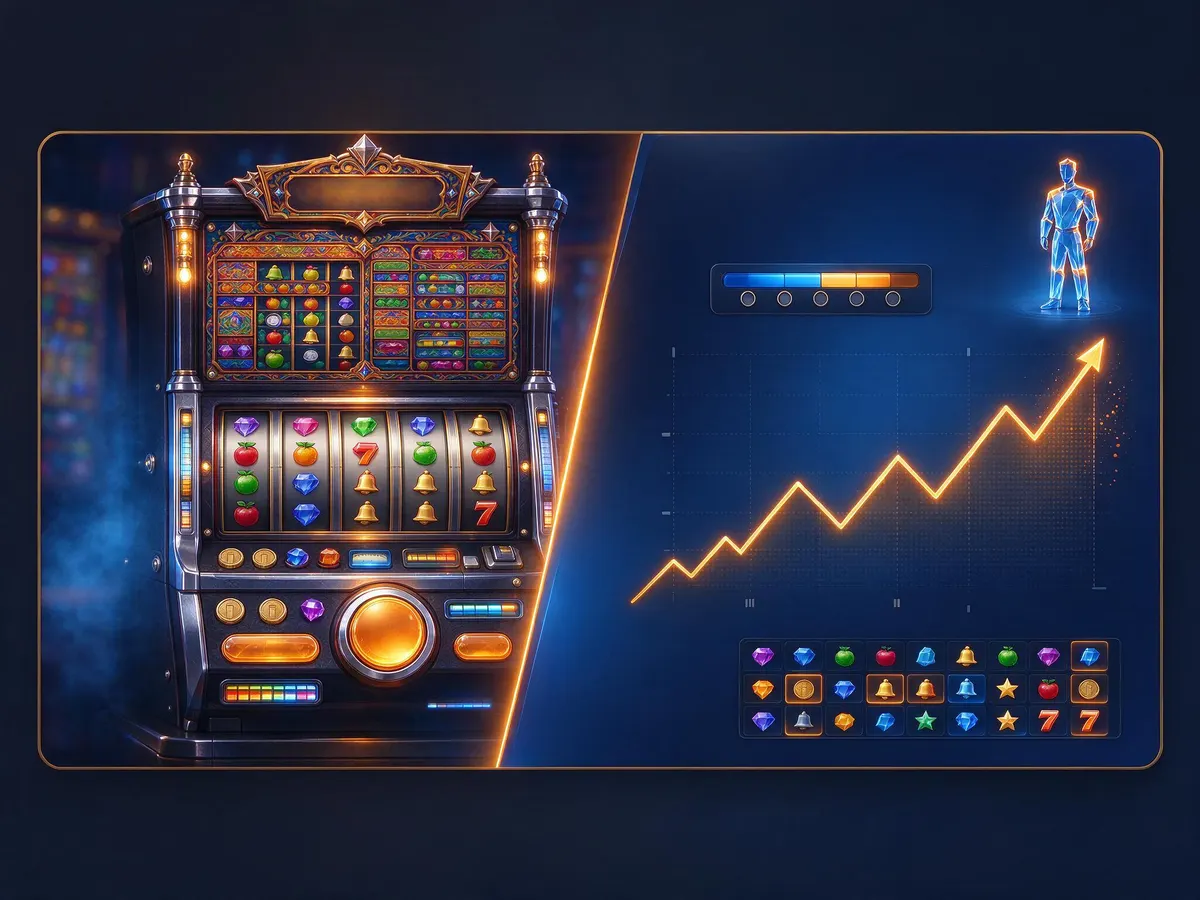
What really drives player engagement in modern casino game design: RTP and volatility, crash multipliers, missions and skill-based bonus rounds.
When you open a game you have never played before, what makes you stay past the third round? Most players assume it is the artwork. It almost never is. Good art gets you to tap, but modern casino game design keeps you at the table through maths, pacing and feedback loops you can learn to read, which is exactly why the same visually polished titles can feel flat after five minutes while a plain looking crash game holds a room for hours.
Levan Kavtaradze, Head of Partner Development at the studio Galaxsys, put the industry’s shift bluntly in an interview ahead of SBC Summit Lisbon: “Simply launching another game or having nice-looking visuals is no longer enough.” That is a supplier admitting out loud what players already sense. Below is what fills the gap, and how you can judge it before you stake a rupee.
Why aren’t good graphics enough anymore?
Because visuals are the cheapest part of the package to copy. There are now thousands of slots and dozens of crash titles competing for the same screen, and a studio can licence a strong art style in weeks. What it cannot fake is a well-tuned maths model, a feature that triggers often enough to feel alive, or an interface that tells you what just happened and why.
Galaxsys itself was at Lisbon showing titles including InstaWin, Infinity, Tower Rush and Olympian Legends, which is a fair snapshot of where the category is going: instant-outcome games, crash-style rounds and themed hybrids rather than straight five-reel clones. The useful takeaway for a player is simpler. If a game’s only distinguishing feature is how it looks, you are paying the same house edge for less game.
What actually drives player engagement?
Three things, in roughly this order: the mathematical model, the reward schedule, and whether the game feels inhabited by other people. Treat these as the real feature list behind the marketing art.
The mathematical foundation: RTP and volatility working together
RTP (return to player) is the long-run share of all wagers a game returns, averaged over millions of rounds. Most slots sit around 94% to 97%, which means a house edge of 3% to 6%. A 96% RTP game returns roughly ₹96 per ₹100 wagered across that enormous sample, not across your session, and never as a promise to any individual.
Volatility describes how that return is distributed. High volatility means rare but larger wins; low volatility means frequent small ones. It does not change RTP at all, which is the single most misunderstood point in casino maths. A well-designed game states both clearly and tunes them to its format: a crash game that most players cash out of early needs a different distribution from a slot built around a once-in-500-spins bonus round.
Watch for one practical catch. Some slots ship in multiple RTP configurations and the operator chooses which to deploy, so the same title can run at 96% on one site and noticeably lower on another. Check the game’s info panel, not a review from two years ago.
Variable reward schedules, explained honestly
Casino games pay out on an unpredictable schedule, and unpredictable rewards hold attention far better than regular ones. Behavioural psychology has known this for decades; game designers use it deliberately. Near-miss animations, anticipation reels that slow down on the third scatter, rising sound pitch as symbols land, all of it stretches the moment before an outcome that has already been decided by the RNG.
None of that is cheating. The outcome is random and independent, and the maths is published. But it is worth naming the mechanism, because the same design that makes a game satisfying is what makes it easy to play longer than you planned. Knowing that a near miss carries exactly zero information about the next spin is a genuinely useful piece of player literacy.
Social elements and competition
Live player counts, shared bet feeds, tournaments, leaderboards and chat turn a solitary game into something closer to a room. In India you can see the appeal clearly in live Teen Patti and Andar Bahar tables, where the dealer and other players carry a chunk of the entertainment value.
Tournaments and missions deserve a sceptical read, though. Most are operator promotions layered on top of the game, with their own terms: qualifying bets, minimum stakes, prize pools split across hundreds of positions, and wagering requirements on any bonus prize. The game feels more engaging; your expected value does not improve.
How do crash games use player psychology?
Crash games strip casino design back to one decision, repeated. A multiplier climbs from 1.00× and can stop at any random point. Cash out in time and your stake is multiplied; wait too long and the round is lost. That single decision is why the format spread so fast.
The multiplier tension effect
In a slot you press spin and watch. In a crash round you are holding a live position, and every tenth of a second the number on screen is worth more and more likely to vanish. Tension comes from the player’s own hand being on the trigger, not from animation. It is also why rounds feel long when they last eight seconds.
Cash-out decisions and the regret loop
Every outcome teaches you something that is not actually true. Cash out at 1.80× and watch it run to 12× and you feel you were timid. Hold for 5× and crash at 2.1× and you feel reckless. Both feelings are noise. Each round is independent, the crash point is generated randomly, and no amount of pattern reading on the history strip changes the house edge built into the model.
Decent crash games support this with tools rather than hype: auto cash-out at a set multiplier, auto bet with round limits, visible round history, and provably fair verification that lets you check a round’s outcome against published server and client seeds. If you are new to the format, read a proper crash game guide before you experiment with stake sizes.
Live activity as social proof
The scrolling list of other players’ bets and cash-outs does real design work. It proves the game is busy, it shows outcomes happening to people other than you, and it quietly suggests what “normal” behaviour looks like. Useful context, but remember that a feed highlighting large multipliers is showing you survivors, not the full distribution of results.
What has actually changed in slots beyond spinning reels?
The reels are the least interesting part now. Three layers sit on top.
Progression and achievements. Collection meters, level-ups, symbol upgrades that persist across spins, and bonus-buy ladders. The good versions give you something to track within the base game so dead spins still advance a state. The hollow versions are a progress bar that resets when you close the tab.
Skill-flavoured bonus rounds. Pick-and-click prizes, aim-and-shoot features, timing based mini games. Be clear-eyed here: in licensed slots the outcome range of a bonus round is defined by the maths model, so your choices usually select between pre-weighted results rather than improving them. Genuine skill influence is rare and, where it exists, is tightly bounded. Treat these as pacing and participation features, not as an edge.
Narrative and theme integration. A theme earns its place when mechanics match the story: a tower that grows as your multiplier builds, a map that unlocks new feature sets. Everything else is wallpaper over the same 20-line engine.
How can you tell a well-designed game from a shallow one?
Spend two minutes on this before you deposit anything. Most of it is readable straight from the game’s own screens.
| What to check | Where to find it | What it tells you |
|---|---|---|
| RTP figure | Info or paytable screen | The house edge you are accepting; also whether the operator runs a lower RTP variant |
| Volatility rating | Game info, studio page | Whether swings match your stake size and patience |
| Max win / max multiplier cap | Paytable, rules | The real ceiling, which is often far below the marketing figure |
| Feature trigger details | Rules section | How often the game actually does something interesting |
| Auto cash-out and bet limits | Game controls (crash games) | Whether you can pre-commit to a decision instead of reacting |
| Provably fair verification | Round history, fairness tab | You can audit outcomes rather than trust them |
| Demo mode | Lobby or game menu | You can learn the rhythm at zero cost |
Red flags are just as readable. No published RTP anywhere. A paytable written so vaguely you cannot work out what triggers the bonus. No demo play. Countdown timers or “last chance” messaging around a promotion. A crash game with no auto cash-out and no verifiable round history. And the oldest tell of all: copy that talks about guaranteed strategies or patterns, which cannot exist in an RNG game by definition.
One more test that costs nothing. Play 50 spins or rounds in demo and ask whether the game gave you anything beyond the artwork: a decision to make, a meter to build, a feature that showed up. If nothing happened, no graphics budget will fix it.
Understanding engagement mechanics is useful precisely because it cuts both ways. These games are built to hold attention, every one of them carries a house edge, and over time the house wins. Set a deposit limit and a session limit before you start, treat the spend as entertainment rather than income, and use the cool-off and self-exclusion tools your operator is required to offer. If play stops feeling optional, step away and read our responsible gambling guidance.
