






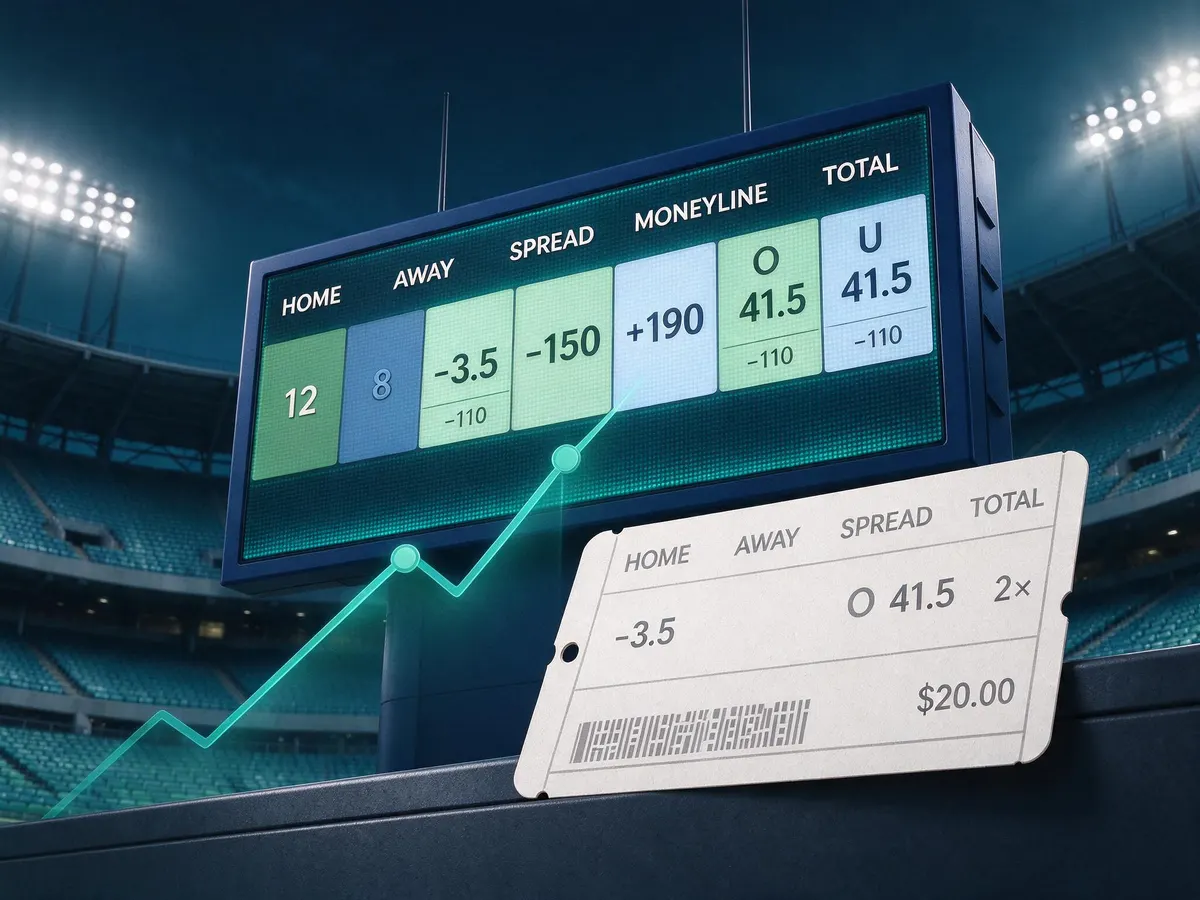
How sportsbooks make money, explained through NFL Week 4's underdog upsets: the vig, point spreads, parlay exposure and bookmaker margins in plain numbers.
How sportsbooks make money, and why Week 4’s upsets didn’t hurt them
NFL Week 4 underdogs went 8-4-2 against the spread with five outright upsets, according to OddsTrader. By the usual logic, that should have been a bloodbath for Las Vegas. Instead, a senior trading manager at BetMGM called it “a positive day for the book.”
That gap between what bettors assume and what actually happened is the fastest way to understand how sportsbooks make money. They are not in the business of predicting games. They are in the business of pricing them, collecting a margin on every bet, and managing the risk left over when the money lands unevenly on one side.
The vig, explained with small numbers
The vig (also called juice, or the bookmaker margin) is the fee baked into the odds. On a typical NFL point spread, both sides are priced at -110 in American terms, or roughly 1.91 in the decimal format most Indian betting sites display. You risk ₹1,100 to win ₹1,000.
Now imagine two bettors, one on each side, both staking ₹1,100 at -110. The book collects ₹2,200. One bettor wins and gets back ₹2,100 (stake plus profit). The other gets nothing. The sportsbook keeps ₹100 regardless of who won.
That ₹100 on ₹2,200 of handle is a 4.55% hold. Look at it through implied probability and the same number appears from a different angle:
| Side | American odds | Decimal odds | Implied probability |
|---|---|---|---|
| Favourite -3.5 | -110 | 1.91 | 52.38% |
| Underdog +3.5 | -110 | 1.91 | 52.38% |
| Total | — | — | 104.76% |
The two probabilities add up to more than 100%. That extra 4.76% is the overround, and it works out to about 4.55% of everything wagered. It is the same idea as the house edge in a casino game, just expressed through prices instead of a payout table.
Why sportsbooks don’t need to pick winners
A perfectly balanced book is a sportsbook’s ideal: equal liability on both sides, the vig collected, zero outcome risk. In that world the trader’s opinion about Drake Maye or the Bills defence is irrelevant.
Real books are never perfectly balanced. Money arrives in waves, the public loves favourites and big names, and sharp money shows up late at better prices. So traders end up carrying a position on most games. They are running a risk management operation, not a crystal ball. The vig is the edge; line management is how they protect it.
NFL odds explained through what actually happened in Week 4
Week 4 is a clean case study because the underdog surge hit the exact bets the public had loaded up on. Favourites in parlays, favourites on moneylines, big names to score touchdowns.
The result that mattered most came in Buffalo. The Patriots, who had been beaten 35-6 by Jacksonville a week earlier with Maye fumbling twice and throwing two interceptions before being pulled, walked into Highmark Stadium and beat the 3-0 Bills 29-26. Maye finished 22 of 37 for 269 yards, three touchdowns and one interception, with a 97.7 passer rating and a 91.0 QBR, plus 54 rushing yards on eight carries.
Caesars Sportsbook’s head of football, Joey Feazel, called Buffalo “the biggest result for the book,” noting the Patriots took down one of the most heavily bet parlay teams of the day. BetMGM’s Christian Cipollini said the Titans and Dolphins covering helped, and that “the Bills losing broke up many of the common big favorite parlay bets.”
Here is how the day’s notable results split between the book and the bettors:
| Game | Line noted | Final score | Who it favoured |
|---|---|---|---|
| Patriots at Bills | New England underdog | NE 29-26 | Sportsbooks (busted favourite parlays) |
| Chiefs at Raiders | Raiders +5 (BetMGM) | KC 30-27 | Underdog backers (dog covered, 4-0 ATS) |
| Panthers at Lions | Carolina +3 | CAR 32-26 | Sportsbooks (Detroit -3 took 80% of BetMGM handle) |
| Jaguars vs Bengals | — | JAX 22-17 | Sportsbooks |
| Cowboys vs Texans | — | DAL 34-30 | Sportsbooks |
| Colts vs Commanders (London) | Indianapolis -225 moneyline | IND 30-13 | Bettors |
| Eagles at Rams | — | LAR 24-20 | Bettors |
| Cardinals at Giants | — | NYG 36-24 | Bettors |
| Jets at Bears | — | CHI 23-12 | Bettors |
Bettors did get a strong start. Indianapolis cashed as a -225 moneyline favourite in London, and Derrick Henry’s first touchdown against his former team in Tennessee, plus scores from Josh Allen and James Cook, put touchdown-scorer bettors ahead early. The morning then turned, and in the Super Bowl futures market the Eagles and Texans were among the biggest drifters after their losses.
Notice the Raiders line too. They were 5-point underdogs at Allegiant Stadium and lost 30-27 to Kansas City. They lost the game and still covered the spread, which took them to 4-0 against the spread for the season. That distinction, losing but covering, is the heart of point spread betting.
Point spread betting and where bookmaker risk comes from
A point spread is a handicap. If a team is -6.5, they must win by seven or more for that bet to cash. The underdog at +6.5 wins the bet by either winning outright or losing by six or fewer. The number exists to turn a lopsided matchup into something close to a coin flip, so both sides attract money at -110.
How spreads move the money
Traders open a line based on their own power ratings and projections, then let the market talk. If too much money lands on the favourite, the spread gets longer or the price on that side gets worse, nudging bettors toward the dog. Line movement is not a prediction being updated so much as a steering wheel. The target is a balanced book where the vig does the earning.
Sharp money and public betting pull in different directions. Sharps often take early numbers or late value on unpopular sides. Public money tends to pile onto brand-name favourites, especially in prime-time slots and parlays. Traders read both and price accordingly.
When the balance never arrives
Sometimes the money simply refuses to split. Detroit -3 against Carolina took 80% of BetMGM’s handle as of the Friday before the game. No amount of line nudging was going to even that out, so the book carried a real position: lose heavily if the Lions covered, win heavily if the Panthers did. Carolina won 32-26.
That is bookmaker risk in its purest form. On a game like that, the sportsbook is effectively betting against its customers, with the vig as a small cushion rather than a guaranteed fee.
Why underdog betting weeks cut both ways
The popular assumption is that underdog upsets hurt sportsbooks. The accurate version is that outcomes hurt or help depending on where the money sat, not on whether the winner was favoured.
Underdog weeks tend to help books for one reason above all: parlays. A parlay needs every leg to win, and recreational bettors stuff them with favourites. When the Bills, one of the most heavily backed parlay legs of the day, lost at home, thousands of multi-leg tickets died at once. That is correlated exposure clearing in the book’s favour, and it is exactly what Cipollini described.
The flip side is real. If the public had been loaded on underdogs, or if a week’s upsets had all landed on heavily backed dogs and teasers, the same results would have been painful. Sportsbooks have losing Sundays. They publish them in their quarterly hold figures.
Bookmaker margin in practice
There are two numbers worth separating. Theoretical hold is the margin built into the prices, around 4.55% on a standard -110 spread market. Actual hold is what the book keeps once real betting patterns and real results are accounted for, and it swings week to week.
Parlays are where the margin compounds, which is why books promote them. Take a two-team parlay priced at the common 13/5, which returns ₹2.60 profit on a ₹1 stake. If each leg is a genuine coin flip, the parlay hits 25% of the time, so the average return is 0.25 × ₹3.60 = ₹0.90 per rupee staked. That is roughly a 10% hold, more than double the single-bet margin, before you add a third or fourth leg.
So the business looks like this. On a balanced market, the book wins slowly and certainly. On an unbalanced market, it takes a position and the result decides. Across thousands of markets and millions of tickets, the margin grinds forward, which is why the house wins over time even when a given Sunday goes badly.
Sports betting basics worth remembering
If you take four things from Week 4, take these:
- The vig is the product. Every price carries a margin, and that margin is why sportsbooks profit without forecasting results.
- Spreads and line movement are tools for balancing action, not published predictions of the final score.
- Covering and winning are different outcomes. The Raiders lost by three as 5-point dogs and still beat the number.
- Parlays carry a much larger built-in margin than single bets, and they concentrate the book’s risk and reward into popular favourites.
Understanding the mechanics makes you a better-informed bettor, not a winning one. The margin is structural, it applies to every bet you place, and no amount of reading shifts the long-term maths in your favour. If you do bet, treat the stake as entertainment spend, use deposit and loss limits, and step away with the cool-off tools licensed operators provide if it stops feeling like a game.
