



How gaming technology suppliers like Renova expand their casino presence, why operators outsource, and what supplier growth says about industry health.
Casinos don’t build their own slot machines. They don’t write the math models, assemble the cabinets, code the player tracking system, or fix the bill validator that jams at 2 a.m. on a Saturday. The floor you walk across is assembled from the work of dozens of outside vendors, and the operator’s actual contribution is often the carpet, the lighting, and the decision about which vendors get space.
That’s the part of the industry a company like Renova Technology lives in. It isn’t a brand players recognise, and it isn’t trying to be. It’s a gaming technology supplier, and the trip it’s making to G2E 2026 in Las Vegas is a useful window into how the whole B2B gaming ecosystem works, who pays whom, and what supplier expansion actually tells you about the health of the market.
What a gaming technology supplier actually supplies
A gaming technology supplier is any B2B company that provides the products or services a casino needs to run but doesn’t make itself. That covers far more ground than most people assume. Game content is only the visible layer.
Break the stack apart and you get roughly six categories, each with its own commercial logic:
| Supplier layer | What they provide | Typical commercial model |
|---|---|---|
| Game studios | Slot titles, table game math and side bets, live dealer studios, RNG-certified game logic | Licence fee or revenue share on participation games |
| Hardware manufacturers | Cabinets, curved displays, button decks, note acceptors, ticket printers, electronic table terminals | Outright purchase or lease, plus service contract |
| Systems and infrastructure | Casino management systems, player tracking and loyalty, wide-area progressive links, cage and accounting software | Licence plus implementation and ongoing support |
| Payments and cash handling | Ticket in/ticket out, cashless wallets, cage kiosks, ATMs, redemption terminals | Fixed fee, per transaction, or both |
| Compliance and responsible gaming | ID and age verification, geolocation, self-exclusion checks, deposit and loss limit tooling, audit trails | Subscription or per-check pricing |
| Lifecycle and logistics services | Repair, refurbishment, reverse logistics, spare parts inventory, asset tracking | Per unit serviced or managed service contract |
Nobody plays a reverse logistics programme. But if the ticket printers on a 1,500-machine floor start failing and there’s no repair pipeline, the floor earns nothing while they sit dark. That last row is where Renova operates, and it’s the least glamorous and most quietly important part of the list.
Renova Technology’s G2E 2026 run: casino tech expansion from the service end
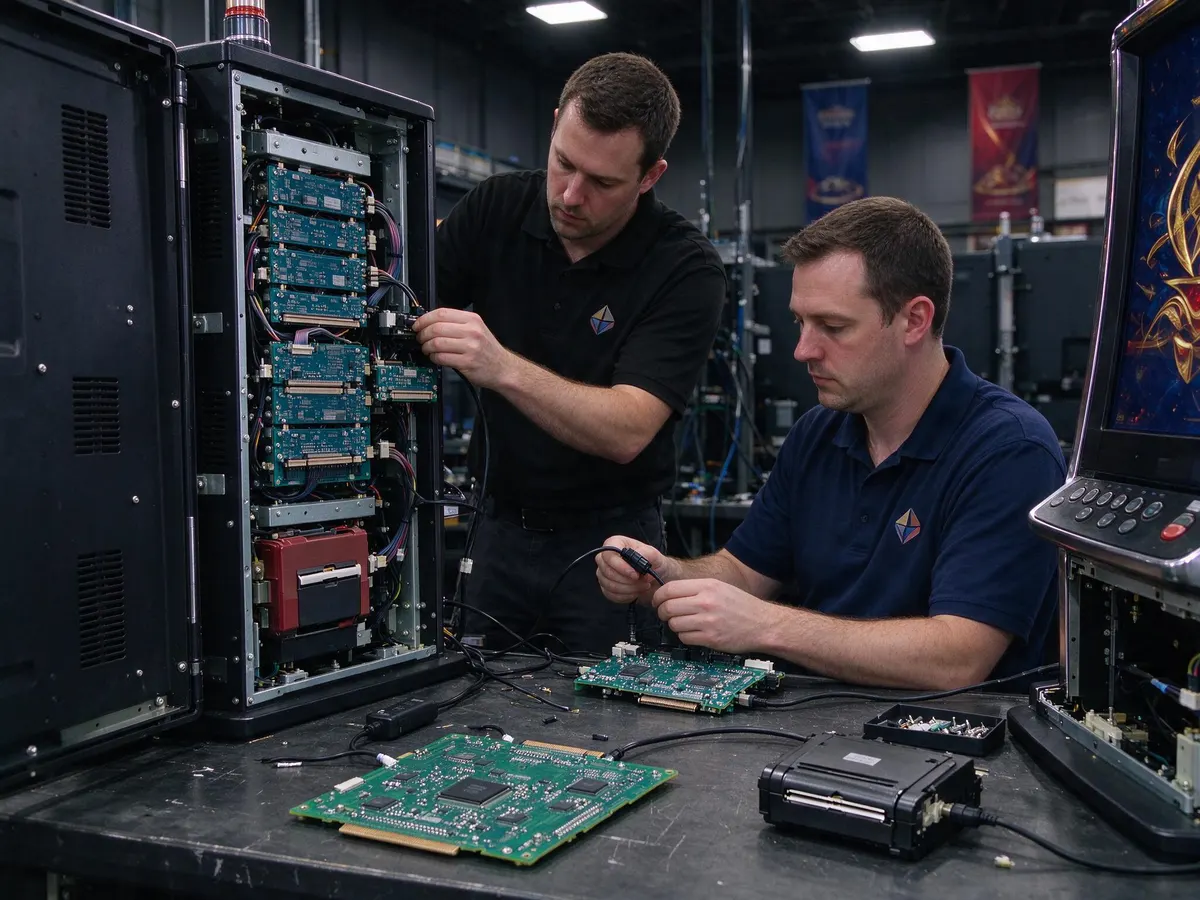
Renova Technology is a Georgia-based company providing equipment repair, reverse logistics and supply chain services. In gaming, that means diagnosing and repairing hardware, extending the working life of equipment that would otherwise be scrapped, and collecting failure data that tells manufacturers why components break in the first place.
Chief Marketing Officer Louis Pine put the G2E objective plainly in an interview with CDC Gaming: “We’re looking to develop new relationships and new partners.” That’s the honest version of a trade show strategy. Not a product reveal, not a stage show. Relationships.
How the company grew its gaming business is the more interesting part. According to Pine, Renova took on the repairs other vendors found difficult, then shared detailed findings back with the manufacturers whose equipment it was fixing. That’s a deliberate way to climb the value chain: start as a pair of hands, end up as a source of engineering intelligence. A supplier that can tell a manufacturer which component fails and why has a conversation that goes well beyond unit pricing.
The company has also packaged that work into Renova 360 Enterprise, an offering that brings repair, logistics and inventory services together with the aim of keeping equipment in service longer while tracking it across its working life. Pine has framed the approach around sustainability, which in this corner of gaming is not a branding exercise so much as arithmetic: refurbishing a working cabinet costs less than replacing it, and the carbon maths follows the money.
Renova is also a Gold Sponsor of CDC Gaming’s Day Zero Party on September 27 at Allē Lounge on 66 at Resorts World Las Vegas, an invitation-only event celebrating the 2026 10 Women Rising in Gaming honorees in partnership with Global Gaming Women. Sponsorship of that sort is the other half of a supplier’s show strategy, and it’s not decoration. It buys a room full of operators and manufacturers in a setting where nobody’s shouting over a demo cabinet.
Why G2E gaming suppliers treat one week as the whole year
G2E is the gaming industry’s main annual trade show in Las Vegas, and for most suppliers it’s less a marketing expense than a compressed sales cycle. Operators send the people who actually sign things. Manufacturers bring roadmaps. Regulators, consultants and analysts circulate. Three or four days produce the introductions that would otherwise take a year of flights.
What suppliers are typically chasing on that floor:
- Distribution — one agreement with a multi-property operator or a large manufacturer is worth more than a dozen single-site deals.
- New verticals — a vendor serving retail or banking hardware uses the show to prove it understands gaming’s compliance and uptime demands.
- Geographic reach — tribal, commercial, Latin American and Asian buyers are all in the same building for once.
- Pipeline for the next twelve months — most contracts signed in Q1 started as a conversation in late September.
So when a services company books a presence and sponsors the surrounding events, read it as a stated intention to grow rather than defend. Companies that are happy with their current book of business don’t spend money meeting strangers.
Build it in-house or partner with gaming hardware providers?
This is the decision every operator revisits, and for the overwhelming majority of properties the answer is partner. The reasons are unromantic.
| Consideration | Build in-house | Supplier partnership |
|---|---|---|
| Upfront cost | Engineering, tooling, certification, staff | Capex on units or a service fee |
| Speed to floor | Years for anything novel | Weeks to months, often pre-certified |
| Regulatory burden | Operator owns every approval in every jurisdiction | Supplier holds licences and test-lab certifications |
| Specialist skills | Must hire and retain scarce technicians | Rented at scale across many clients |
| Flexibility | Sunk cost, hard to abandon | Contract terms, replaceable vendor |
| Differentiation | Genuinely proprietary if it works | Rivals can buy the same thing |
Only the last row favours building, and even then most operators conclude their differentiation lives in hospitality, loyalty and location rather than in hardware engineering. A supplier spreads certification costs and spare parts inventory across hundreds of customers. An operator building the same capability carries all of it alone, for one floor.
The working relationship usually follows a predictable arc: technical integration with the casino management system and accounting feeds, compliance sign-off in each jurisdiction, installation and staff training, then an ongoing support agreement with uptime commitments. Payment varies by layer. Participation slot cabinets often sit on revenue share, systems on licence plus support, and lifecycle services on per-unit or managed-contract pricing. None of it is passive income for the vendor; a supplier whose gear fails during a holiday weekend is a supplier with a short contract.
The verdict: what supplier growth really signals
Supplier expansion is one of the better leading indicators in gaming, because suppliers get paid before operators see the return. New cabinets, new systems and new service contracts are all decisions operators make when they expect the floor to justify the spend. Vendors scaling up are, in effect, reporting on their customers’ confidence.
But the type of growth matters, and this is where the Renova case study is more informative than a flashy content launch would be. Expansion in repair, refurbishment, asset tracking and equipment lifespan isn’t the signature of an industry splurging on new hardware. It’s the signature of one scrutinising cost per unit and squeezing more years out of what it already owns. Both can be true at once: capital is available, and it’s being watched closely.
So the honest reading of casino industry trends through the supplier lens is this. The companies winning new partners right now are the ones selling efficiency, data and uptime rather than novelty. For investors, that points attention at the unglamorous service and infrastructure layer instead of the headline game studios. For operators, it’s a reminder that the vendor who can tell you why your hardware fails is worth more than the one who simply sells you more of it. And for anyone who assumed the casino built the machine, the machine was built, shipped, certified, repaired and tracked by companies you’ve never heard of, all of whom will be in Las Vegas in September looking for the next contract.